


Orifices and weirs is the free GeoStru geoapp for the hydraulics of orifices under head (sharp-edged free or submerged, thick wall, large rectangular orifice, sluice gate) and of weirs (Bazin, Rehbock, SIA, Francis with end contraction, Cipolletti, Thomson V-notch, broad-crested), including tailwater submergence. For each case you choose what to find: the discharge from geometry and head, the head needed for a discharge, or the size (width, diameter, opening) for a given discharge and head. It compares several cases, draws the rating curve and produces the report as a PDF. It runs in the browser, with no installation, also on the phone, and no data leaves your computer.
What orifices and weirs are
They are the two ways water leaves a tank, a basin or a channel through an opening. An orifice under head is a hole below the free surface (the bottom outlet of a basin, the mouth of a flow divider, the opening under a gate): water leaves with the velocity given by the head, the depth of water above the hole, and the discharge grows with the square root of the head. A weir is a crest over which water spills (a spillway, a check structure, a plate in a measuring flume): the discharge grows with the head over the crest to the power 1.5 (2.5 for the V-notch). All formulas carry a coefficient from experiments (μ, Cd, Cc) that accounts for the contraction of the jet and for friction, and each holds within a range of heads and sizes: that is why several formulas exist for the same rectangular weir (Bazin, Rehbock, SIA), and the application warns when the data leave the experimental range. When the tailwater rises above the hole or the crest the flow is submerged and the discharge drops.
What it does
- Cases (up to 8): each with its type, the unknown and the fields of the type, which change by themselves; the chosen unknown disappears from the fields and the discharge to obtain appears. Everything is recomputed at every keystroke, Duplicate gives you a variant in a second.
- Orifices: sharp-edged free Q = μ·A·√(2gh); submerged with h₁ − h₂; thick wall (short tube, μ 0.82, with a check on the wall thickness); large rectangular orifice with the integrated formula; sluice gate with free or submerged flow and vena contracta Cc·a. Circular or rectangular shape.
- Weirs: Bazin, Rehbock and SIA (sharp-crested rectangular, with the crest height), Francis with 0/1/2 end contractions, Cipolletti (trapezoidal 1:4), Thomson (V-notch, angle and Cd of your choice: 1.40·h^2.5 at 90°), broad-crested with the H/L check. Villemonte submergence for all, given the tailwater level above the crest.
- Validity ranges: each formula warns when the data leave its experimental range (Bazin 0.08-0.70 m, Rehbock h/p ≤ 1, Thomson 0.05-0.38 m, Cipolletti h ≤ b/3, broad-crested 0.08 ≤ H/L ≤ 0.33, small orifice with low head, gate out of the water, drowned weir…).
- Results: sketch with the dimensions of the case (section for orifices and rectangular weirs, front view for Francis, Cipolletti and Thomson), discharge in m³/s and l/s, coefficient used, velocity, flow regime, formula; comparison table between cases.
- Rating curve: discharge against head with fixed geometry, chart and table, to read the discharge in operation from the measured level; exported as CSV for Excel.
- Report / PDF: header with title, professional and date, summary line of each case, sketches, results, comparison, rating curve and a Method paragraph with all the formulas. Print it or save it as PDF from the browser.
- Save / Open: the work is saved to a
.jsonfile with the name you choose and reopened; it also stays in the browser between sessions.

How to use it
- Type the title and the professional (they go into the report).
- In each case pick the type from the list (orifices on top, weirs below) and with Find the unknown: discharge, head or size. For head and size the field Discharge Q to obtain appears.
- Fill in the fields: for orifices the head is on the centroid of the opening (on the upper edge for the large orifice, from the bottom for the gate); for weirs the head is above the crest, p is the crest height from the bottom and h₂ the tailwater level above the crest (0 = free). Coefficients already carry the recommended value and can be changed.
- Read the result next to the sketch, check the warnings on the validity range, compare the cases, export the rating curve, print the report.

Rating curve and comparison
For the chosen case the rating curve gives the discharge for a series of heads up to one and a half times the head of the case, with the case point highlighted. It is the table that goes into the report of a flow divider or a measuring weir, and the one used to read the discharge from the staff gauge. The comparison table lines up all the cases with discharge, head, geometry, coefficient and regime.
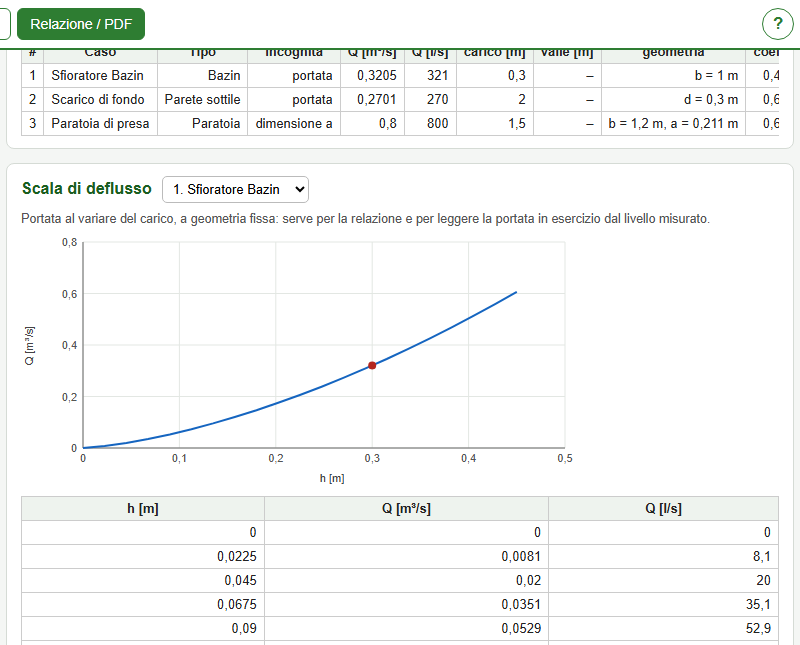
The report
With Report / PDF the page becomes the document: header, summary line of each case with all the data, sketches, results, comparison, rating curve and the Method paragraph with the formulas, ready to be attached to the project.

On the phone
The page adapts to small screens: fields on one column, sketches and charts at full width. Handy in the field, to estimate the discharge of a weir from the measured head.

Method
Orifices. Small sharp-edged orifice Q = μ·A·√(2gh), h on the centroid, μ ≈ 0.61; submerged orifice Q = μ·A·√(2g(h₁ − h₂)); thick wall (short tube, thickness 2-3 times the opening) μ ≈ 0.82 as the jet reattaches; large rectangular orifice Q = ⅔·μ·b·√(2g)·[(h+a)^1.5 − h^1.5] with h on the upper edge; sluice gate Q = Cc·a·b·√(2g(h₁ − Cc·a)) with free flow, Q = Cc·a·b·√(2g(h₁ − h₂)) when submerged (h₂ > Cc·a), Cc ≈ 0.61.
Weirs. Bazin Q = μ·b·h·√(2gh) with μ = (0.405 + 0.003/h)·[1 + 0.55·(h/(h+p))²]; Rehbock Q = ⅔·Cd·b·√(2g)·hₑ^1.5, Cd = 0.602 + 0.083·h/p, hₑ = h + 0.0011 m; SIA Q = ⅔·μ·b·√(2g)·h^1.5, μ = 0.615·[1 + 1/(1000h + 1.6)]·[1 + 0.5·(h/(h+p))²]; Francis Q = 1.838·(b − 0.1·n·h)·h^1.5; Cipolletti Q = 1.86·b·h^1.5; Thomson Q = 8/15·Cd·tan(θ/2)·√(2g)·h^2.5 (1.40·h^2.5 at 90° with Cd = 0.593); broad-crested Q = Cd·(⅔)^1.5·√g·b·H^1.5 = 1.705·Cd·b·H^1.5 with critical flow on the crest (Cd 0.85-1.0). Submerged weir: Villemonte reduction Qₛ = Q·[1 − (h₂/h)^k]^0.385 with k = 1.5 (2.5 for the V-notch). The inverse problems (head or size for a given discharge) are solved by bisection, since the discharge grows with head and size.
Related applications
Design hyetographs · Hydraulic invariance · Uniform flow · Head losses in pressure pipes · Ditch hydraulic design
References
GeoStru Orifices and weirs — version 1.0.1, 15 September 2026. Bazin H. (1898), Expériences nouvelles sur l’écoulement en déversoir; Rehbock T. (1929), Wassermessung mit scharfkantigen Überfallwehren; Villemonte J.R. (1947), Submerged-weir discharge studies, Engineering News-Record; Bos M.G. (1989), Discharge measurement structures, ILRI. Free application; the computation runs in the browser and no data is sent to the server. The interface is in Italian.
Apri