


The app performs stability analysis for infinite slopes with up to 3 soil layers. It also accounts for the presence of a water table. Features include saving/opening projects and exporting calculation reports in *.docx format.
Infinite Slope Stability Analysis
The infinite slope model is applicable to elongated translational landslides where the influence of the crest and toe portions is negligible. The stability of alluvial or debris soil mantles, characterized by a small thickness compared to the landslide length and resting on a more rigid foundation soil, is typically analyzed using the infinite slope scheme.
Dry Cohesionless Infinite Slope
Consider an infinite slope of homogeneous, cohesionless soil (c’=0) and dry soil (u=0). We isolate a soil slice delimited by two vertical walls, a base parallel to the slope surface at a generic depth z, and a top surface belonging to the slope. By symmetry, the stresses on the lateral faces of the slice are equal and opposite; therefore, their resultants have the same line of action, parallel to the slope and in opposite directions, thus they cancel each other out (they do not enter into the equilibrium equations of the slice).

A tangential and a normal stress will act upon the base.
Let us consider the forces acting on the slice and write the equilibrium equations for horizontal and vertical translation:

Under the following assumptions:
c’ = 0;
ϕ= ϕ’;
u = 0;
σtot= σ’;
N=N’;
we will have:
W = γ⋅z⋅1
N = W⋅cosβ
T = W⋅sinβ
 is assumed to be equal to 1 (unit magnitude)
The equilibrium of the slice is ensured by the forces W, N, and T:

We can write that:

While from the Mohr-Coulomb failure criterion, we have that:

The factor of safety is calculated as the ratio between the available shear strength and the mobilized stress:
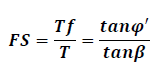
(this is for non-cohesive soils)
For stability, it must be FS ≥ 1 (where FS = 1 represents the limit condition of incipient failure); this equation implies that for the stability of a slope, its inclination β must be less than or equal to the shear strength angle ϕ’.
STABILITY ≥ β ≤ φ’
Therefore, a slope consisting of cohesionless soil (c’=0) with an inclination angle β greater than the shear strength angle cannot exist.
Extending the case to a cohesive soil, where c’≠0, we have:

Therefore, the expression for the factor of safety is written as:

Recalling that in the case of dry soil, we have:
N=N’ e ϕ= ϕ’
Submerged infinite slope
Now let us consider the equilibrium of a homogeneous, cohesionless soil slice totally submerged in water at rest. Under these conditions, in addition to the forces present in the dry soil case, the water thrust will act on the slice. This is the resultant of hydrostatic pressures, which is vertical and directed upwards, known as the buoyancy force Fa. It is equal to the unit weight of water γw multiplied by the volume of the slice. For the total weight W of the slice, we refer to the saturated unit weight γsat. However, the calculation can be simplified by considering the buoyant weight W’ of the slice instead of the two opposing forces Fa and W. As in the previous case, we first consider the cohesionless soil case (c’=0), followed by the cohesive soil case (c’≠0).

Fa = γw⋅z⋅1
W = γsat⋅z⋅1
W’ = γ’⋅z⋅1
W’ = W- Fa
In the case of submerged soil, unlike the previous case, we have:
c’ = 0; ϕ ≠ ϕ’; u ≠ 0; σtot ≠ σ’; N ≠ N’

N′= W′∙cos 𝛽=𝛾′∙z∙cos𝛽
T= W′∙sin𝛽=𝛾′∙z∙sin𝛽
T= N′∙tan𝜑′=𝛾′∙z∙cos𝛽∙𝑡an𝜑′
In this case as well, the expression for the factor of safety for non-cohesive soils reduces to:

That is, the factor of safety yields the same result as previously seen for the slope in the absence of a water table; the result changes, however, if the slope is composed of cohesive material or if it is affected by seepage flow.
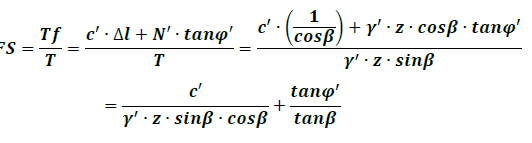
Extending the case to a cohesive soil, where c’≠0, we have:

Therefore, the expression for the factor of safety is written as:
Seepage parallel to the slope
The infinite slope model with seepage parallel to the slope is generally used to verify the stability of a soil mantle following prolonged rainfall. This is because water in the soil is not present only in static conditions; in fact, soils are often the site of seepage flow, and moving water alters the stress state of the soil, thus influencing its mechanical behavior.
Given the low seepage velocities of water, it is assumed that the flow is laminar and steady-state. In this regard, let us consider the case where the infinite slope is the site of a steady-state seepage flow parallel to the slope.
In this case, we consider a piezometer measuring at point B, at a depth z from the ground surface, where the water head is hp. This is calculated by considering the equipotential line passing through B, extended to the ground surface—which in this case coincides with the saturation line—at point A, from which a horizontal line is drawn.

Through simple geometric considerations, the height hp can be calculated:

AB = z⋅cos β
hp = AB⋅cos β
from which:
hp = z⋅cos2 β
Therefore, the water pressure at point B will be:
uB = γw⋅hp = γw⋅z⋅cos2β
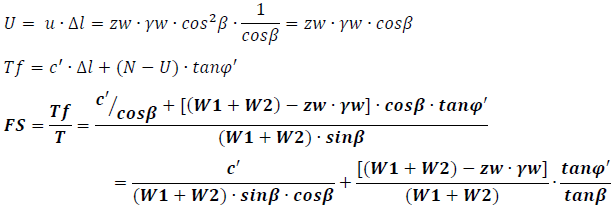
Therefore, in the case of seepage parallel to the slope, the equilibrium involves an additional force to consider: the resultant of the pressure acting on the base, U. The scheme to be considered will thus be:

W = γsat⋅z⋅1
N = W⋅cosβ = γsat⋅z⋅cosβ
T = W⋅sinβ = γsat⋅z⋅sinβ
U = u⋅Abase
Where
u = γw ⋅z⋅cos²β
Abase=Δl⋅1 = 1/cosβ
U = u ⋅ Abase = γw ⋅ z ⋅ cosβ
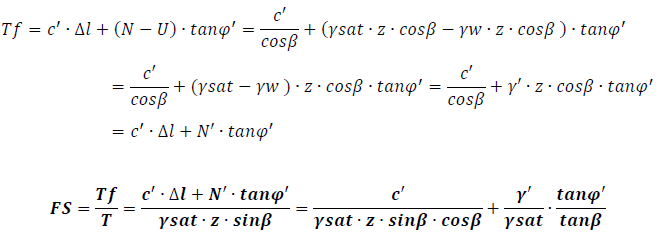
In the case of cohesionless soil c’=0:


Since γsat > γ’ it can be noted from this relationship that the factor of safety is reduced exactly by the ratio γ’/ γsat, which is nearly a 50% reduction. Consequently, the maximum stable inclination of the slope becomes approximately φ’/2, (again, in the case where c’=0)
In the case of cohesive soils c’≠0 we have:
General Case
Let us consider an infinite slope where seepage flow is present and the soil is cohesive.

We denote z as the thickness of the slope (the depth of the slip surface), while $m \cdot z = h_w$ represents a fraction of $z$ and identifies the height of the water table from the bottom.
At the base of the slope, a pressure u=γw·m·z·cos2β, is present. On a soil slice of weight W the stresses σ,τ, u will act at its base.
From the analysis in terms of stresses, we can write:

From these expressions, it is possible to obtain a general expression for the Factor of Safety (FS):

Where for:
- c’=0; m=0 → Dry cohesionless soil
- c’=0; m=1 → Cohesionless soil with seepage, water table at the surface
- c’=0; m≠0 → Cohesionless soil, seepage with water table below the surface
Moto filtrazione verticale

(il carico H è costante lungo le isopieziche, le pressioni sono nulle il gradiente idraulico i= ΔH/ ΔL=1)
Vertical Seepage Flow

(the head H is constant along the equipotentials and the pressures have a hydrostatic distribution)
Seepage flow parallel to the slope
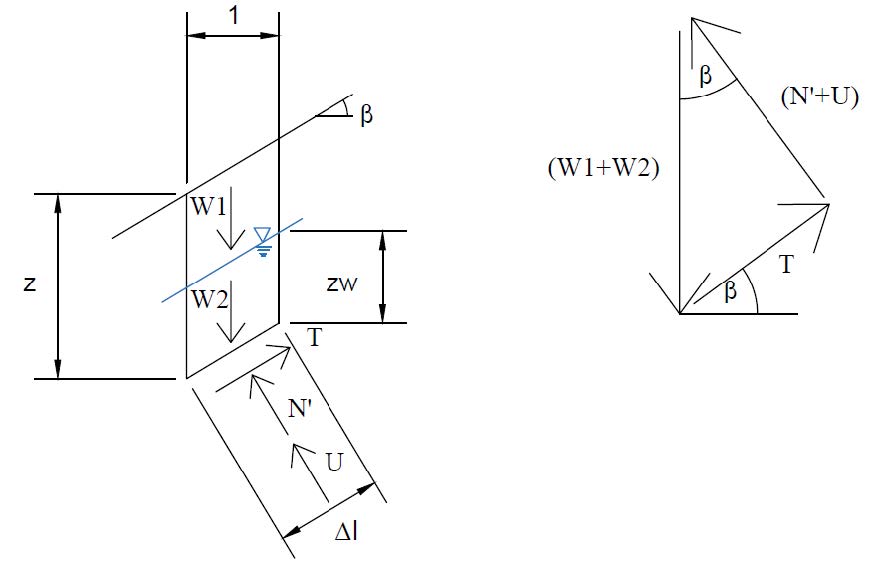
𝑊1=(𝑧−𝑧w )∙ 𝛾
𝑊2=𝑧w ∙ 𝛾sat
𝑁=(𝑊1+𝑊2)∙cos𝛽
𝑇=(𝑊1+𝑊2)∙sin𝛽
IMPORTANT
- As the cohesion c’ increases, the slip surface tends to deepen; a lower cohesion corresponds to a slip surface closer to the ground level;
- n cases of dry soil where φ’ > β, the slope will always be stable. In cases where φ’ < β, for soils with cohesion, equilibrium can only exist up to a certain depth, known as the critical depth, which can be calculated by setting FS = 1.

-
The most unfavorable condition in a slope subject to seepage flow occurs when the flow is in a horizontal direction. This is followed by the condition of seepage parallel to the slope, where the worst-case scenario is when the saturation line coincides with the ground surface, while the most favorable situation is represented by a vertical downward seepage flow;
-
In the event that you are dealing with a slope that has already been affected by landslide phenomena in the past, the strength to which you must refer is the residual strength, which is the strength available on a pre-existing failure surface. The residual strength is characterized by zero cohesion c’_r = 0 and a friction angle lower than the peak friction angle φ‘r < \φ‘p.
-
If the inclination of the flow happens to be different from the inclination of the slope, the pressure u at a certain depth z is:
 Where:
-
- β is the inclination of the slope
- α is the inclination of the flow
- When referring to an event that occurs rapidly, such as a load applied quickly, or when it is specified that the failure occurs without volume changes, the analysis must be performed under undrained conditions, using the undrained shear strength Cu with the Tresca criterion
- In the case of a multilayer slope, the weights acting from each individual layer will be calculated separately. In the presence of a water table, a check is performed based on the height of the latter (Hw) and the relative weight of the saturated soil is calculated according to which layer the free surface of the water table falls into.
Schemes used in the Geoapp

Scheme for 1-layer analysis

Scheme for 2-layer analysis

Scheme for 3-layer analysis